
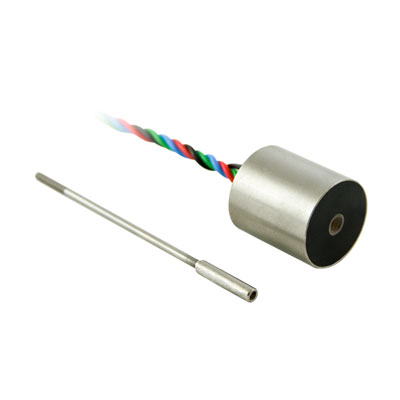
Trans-Tek 0600-0000 sensor
Description
Leading Manufacturer of LVDT Sensors
Specializing in Linear Variable Differential Transformers (LVDT) and Velocity Transducers
Trans-Tek, Inc. is a leading LVDT manufacturer that has been providing the very best Linear and Angular Displacement and Linear Velocity Transducers for over half a century. Our main focus is LVDT (Linear Variable Differential Transformer) technology for linear sensing.
When it comes to solving your measurement challenges, our experienced engineers will find the right LVDT position or velocity sensor to meet your most demanding requirements. Our complete production facility is geared to meet your delivery needs – whether it’s for a standard or custom sensor solution. Our LVDT Research & Development (R&D) program is continuously expanding our product line to address countless industrial applications.
Transtek is committed to manufacturing LVDT sensors that combine precision, durability, and reliability. With a global network of technical representatives and a dedicated team, Trans-Tek ensures that every client receives top-tier service and support. Our mission is to provide competitively priced LVDT products that exceed your expectations in both performance and delivery.
We proudly hold two key industry certifications: the ISO 9000 certification for quality management and the AS9100 quality certification for the aerospace industry. READ MORE
Our LVDT types include:
> AC-AC LVDTs
> DC-DC LVDTs
> Gaging LVDTs
As the core moves in or out of the transformer, the relative inductance between the primary coil and each secondary coil changes, causing a change in the output voltage of the secondary coils. This change in voltage can be used to determine the displacement of the core.
LVDTs are commonly used in industrial applications such as measuring the position of valves, pistons, and other mechanical components just name a few. They are highly accurate and have a wide measurement range.
In Simple Terms, an LVDT is a Measurement Device
An LVDT sensor is a measurement device. It is used to measure linear displacement (or position) of an object. It converts the small linear movement of an object into a proportional electrical signal, which can then be read and interpreted by electronic measurement equipment. The electrical signal produced by an LVDT is directly proportional to the displacement of the core, and can be used to determine the position of the object with high accuracy.
What Does an LVDT Measure?
An LVDT can be used to measure the linear displacement of a wide range of objects, across many different industries. Here are some examples:
Machine Tooling – LVDTs are commonly used in machine tools to measure the position of slides, tables, and other moving parts.
Industrial Process Control – LVDTs are used in process control systems to measure the position of valves, pumps, and other equipment.
Aerospace – LVDTs are used to measure the displacement of various components in aerospace applications such as aircraft flap and landing gear position.
Automotive – LVDTs are used to measure the displacement of various components in automotive applications such as engine valves and gearboxes.
Robotics – LVDTs can be used to measure the position of robotic arms and other moving parts in industrial robots.
Research and Development – LVDTs are used in many research and development settings, such as measuring the displacement of materials in materials testing and measuring the position of components in test stands.
It’s worth noting that LVDT’s are used when linear measurements are needed, other types of sensors like encoders, resolvers, potentiometers and others might be more suitable depending on the application. Series 200
Short Stroke DC LVDTs
The Series 200 DC-DC LVDTs are precision Linear Variable Differential Transformers packaged with a solid state oscillator and a phase sensitive demodulator. The transducer is designed to work with DC voltages, and has excellent linearity, infinite resolution, and high sensitivity. Input and output circuits are electrically isolated from each other and from the coil assembly housing, making them usable directly in floating or ground return systems. DC indicators, recorders, and control systems can usually be driven directly by the large DC output. The core, when displaced axially within the coil assembly, produces a voltage change in the output directly proportional to the displacement.