
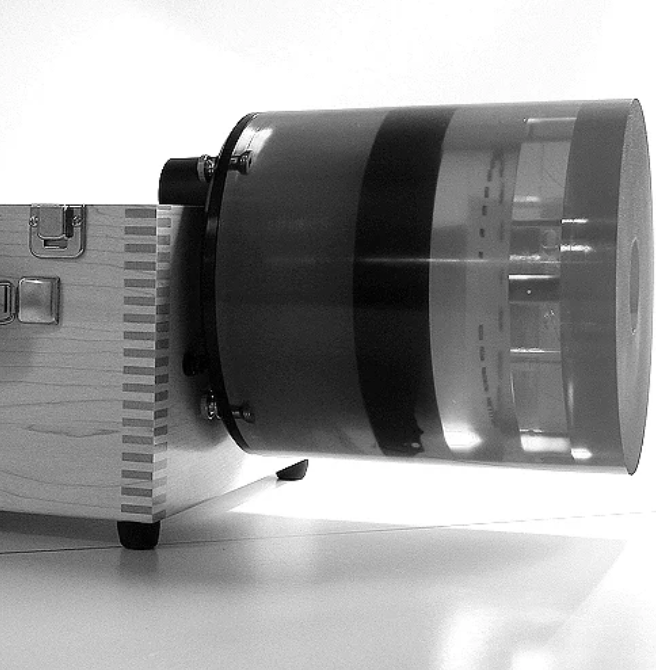
phantomlab ECTphan™ 330 Phantom
Description
The ECTphan™ Phantom is a cylindrical, liquid filled container with a variety of tests for quality monitoring of single photon emission tomography (SPECT) systems .
The phantom can be used to evaluate the following SPECT system parameters: reconstructed uniformity, spatial resolution, low contrast resolution, pixel size, slice width, and center of rotation (COR). Additionally, the ECTphan™ Phantom data is suited for computer based analysis for the system parameters listed above.
For detailed information please refer to the ECTphan™ Manual.
Configurations: The phantom lends itself to a number of user configurations The phantom has an end plate with 4 threaded holes (one in the center and three in a radial pattern) that can be filled with fillable ‘hot’ or ‘cold’ solid low contrast inserts. The contrast inserts can be replaced by plugs when not needed or to increase the uniformity area. A point source holder can be positioned at the phantom center for measurements of PSF, MTF and center of rotation. The test plate can also be removed easily to create a larger uniformity area.
Test-Summary
The ECTphan™ phantom consists of three main test areas: the test plate, a uniformity area and the end plate for inserts.
-
Test Plate
- Pixel Size
- Slice Width
- Spatial Resolution -
Uniformity Section
- Integral Uniformity
- Noise Statistics -
End Plate
- Low Contrast Measurements (‘Hot’ or ‘Cold’)
- PSF
- MTF
- Center of Rotation.
Phantom Components
Test Plate: The test plate has 4 ‘hot’ holes spaced 120mm apart for measuring pixel size in X and Y axes. Four bar patterns up to 2.5lp/cm are available for visual evaluation of spatial resolution. Two opposed angled ramps provide the ability to measure slice thickness.
Uniformity Section: The uniformity section provides a 20cm diameter area that can be visually examined for artifacts and non-uniformities. The integral non-uniformity and RMS noise statistics can be calculated from the pixel values in the area.
End Plate: The end plate has threaded holes to mount the point source holder and the ‘hot’ and ‘cold’ low contrast inserts. When tests are not needed the holes may be plugged with SMR 168 plugs.