
olsoninstruments Crosshole and Downhole Seismic (CS/DS) Seismic
Description
Crosshole and Downhole Seismic (CS/DS) investigations provide information on dynamic soil and rock properties.
The Crosshole Seismic (CS) system and method determine shear and compressional wave velocity versus depth profiles. From these measurements, parameters, such as Poisson’s ratios and moduli, can be easily determined. In addition, the material damping can be determined from CS tests. These dynamic soil and rock properties are often utilized for earthquake design analyses necessary for certain structures, liquefaction potential studies, site development, and dynamic machine foundation design. The most complete version of this downhole system, as manufactured by Olson Instruments, is comprised of a borehole source capable of generating shear and compressional waves and a pair of matching three component triaxial geophone receivers. These instruments are lowered to the same depth in boreholes set at ~ 10 ft (3 m) apart in a line. The instruments are coupled to the side of the grouted borehole inclinometer casing, allowing for the detection of shear and compressional waves as they pass between the receivers.
Tomographic Imaging Software, which is sold by Olson Instruments, allows the user to perform tomographic inversions of CS seismic velocity data which provides 2D or 3D shear or compressional wave velocity images of soil and rock. (Note: Optional Tomo software is available for the CSL, UPV, and CS/DS add-on test methods.)
Data Platform Required, Sold Separately
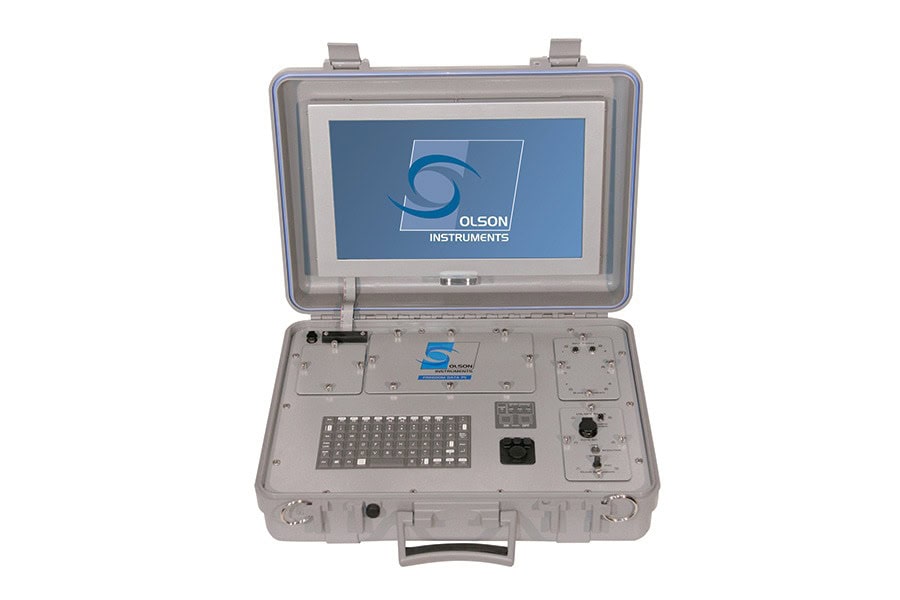
Freedom Data PC
The Downhole Seismic (DS) investigations are similar to CS investigations, but require only one borehole to provide shear and compressional velocity wave profiles. The DS method uses a hammer source at the surface to impact a wood plank and generate shear and compressional waves. This is typically accomplished by coupling a plank to the ground near the borehole and then impacting the plank in the vertical and horizontal directions. The energy from these impacts is then received by a pair of matching three component geophone receivers, which have been lowered downhole and are spaced 5 to 10 ft (1.5 to 3 m) apart.
Applicable On:
Soil & Rock for Seismic and Vibrating Machine Foundation Design
Test For:
Image Voids, Solution Caverns, Washouts with Tomography
Locate Faults, Fractures
Seimic Shear & Compressional Wave Velocities
Meets ASTM:
D4428
D4428M-07
D7400 (DS)
Meets ACI:
N/A