
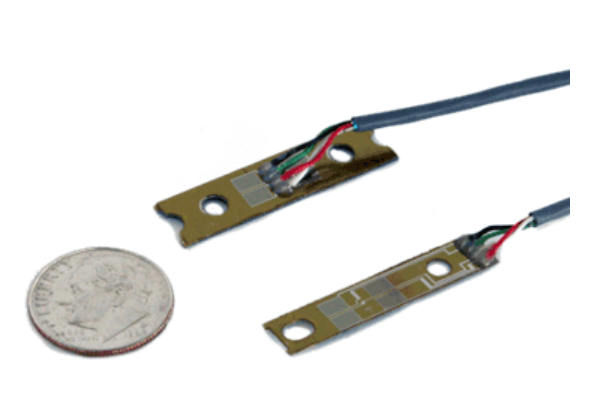
Transducer Techniques GS0-1K 1,000 sensor
Description
TBS SERIES
MADE
CAPACITY RANGES:
.25,.50,1,2,5,
10,20, 40 lb
The TBS Series thin beam force sensors many
different parameters found in medical
instrumentation,home appliances, process
control, robotics, and automotive are
exceptionally suited for small load
measurements. They are designed to
measure and many other high volume
applications.A specially developed integrated
strain gauge includes all balancing,
compensating and conductive elements and
is laminated to the beam to provide excellent
stability and reliability. A load cell is a transducer or sensor that is used to convert a mechanical force or load into an electrical signal. it is a criticalcomponent in various applications where the measurement of force, weight, or tension is reauired, Load cells are commonly used inindustrial, scientific, and commercial settings to obtain accurate and reliable measurements of forces or loads. Here are the keycomponents and functions of a load cel: Strain Gauges: Load cells typically contain one or more strain gauges, which are thin, wire.lik are bonded or attached to a structural element within the load cel. Strain gauges are designed to deform whensubjected to mechanical force, and this deformation results in a change in electrical resistance. Wheatstone Bridge Circuit: Straingauges are configured in a Wheatstone bridge circuit, which is an electrical circuit that can detect small changes in resistance. Whenforce is applied to the load cel,the strain gauges experience deformation, causing a change in resistance, This change in resistanceleads to an imbalance in the Wheatstone bridge, generating an electrical output signal. Output signal: The electrical output signalproduced by the load cellis typically very low in magnitude, often in the milivolt (mV) range. This signal is proportional to the appliedforce or load and can be further processed and amplified to obtain meaningful measurements, Calibration: Load cels must becalibrate ensure accurate and consistent measurements. Calibration involves applying known forces to the load cell andrecording the corresponding output signals. This callbration data is used to establish a relationship between the applied force andthe output signal. Types of Load Cells: There are various types of load cells, each designed for specific applications and load GS0-10 10 ,GS0-25 25 GS0-30 30 ,GS0-50 50 ,GS0-100 100 ,GS0-150 150 ,GS0-250 250 ,GS0-500 500 ,GS0-1K 1,000 ,OPTION-TC N/A ,CAL-TEDS N/A r ,ALS-04 N/A Load Stem (Dia. .200 Length .250) ,ALS-06 N/A Load Stem (Dia. .200 Length .375) ,ALS-08 N/A Load Stem (Dia. .200 Length .500) ,MDB-2.5 2.5 lbs Calibration in Compression ,MDB-5 5 lbs ,MDB-10 10 lbs ,MDB-25 25 lbs ,MDB-50 50 lbs ,MDB-75 75 lbs ,MDB-100 100 lbs ,OPTION-TC N/A ,CAL-TEDS N/A r ,MLP-10 Capacity: 10 lbs ,MLP-25 Capacity: 25 lbs ,MLP-50 Capacity: 50 lbs ,MLP-75 Capacity: 75 lbs ,MLP-100 Capacity: 100 lbs ,MLP-150 Capacity: 150 lbs ,MLP-200 Capacity: 200 lbs ,MLP-300 Capacity: 300 lbs ,MLP-500 Capacity: 500 lbs ,MLP-750 Capacity: 750 lbs ,MLP-1K Capacity: 1,000 lbs ,OPTION-CO N/A ,OPTION-DB N/A Dual Bridge ,OPTION-TC N/A ,CAL-TEDS N/A Plug & Play Option with Connector ,SLB-25 ,SLB-50 ,SLB-100 ,SLB-250 ,SLB-500 ,SLB-750 ,SLB-1K ,CAL-TEDS ,LB0-100 ,LB0-100A LB0-250 ,LB0-500