
Ultrafast Systems EOS IR Absorption Spectrometer
Description
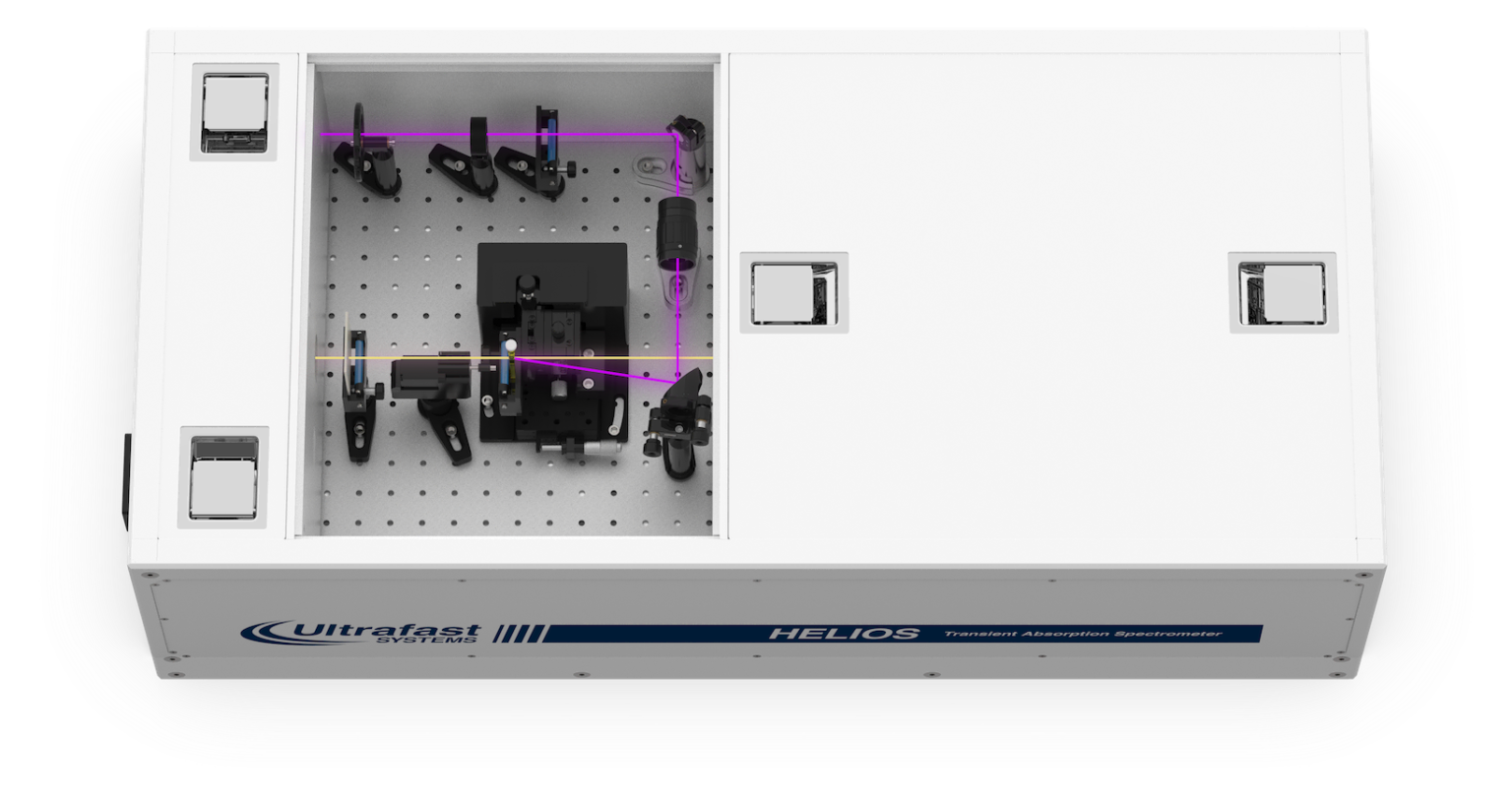
HELIOS is an automated femtosecond Transient Absorption Spectrometer. It is designed to work with a variety of amplified femtosecond lasers, including high-energy Ti:Sapphire amplifiers and high repetition rate Yb amplifiers. Together with our patented optical delay line, HELIOS delivers an unmatched level of performance and user-friendliness.
Spectral resolution optimized for transient absorption
For transient absorption higher spectral resolution is not always better. It is important to map out all the spectral features, but it is also critical to deliver enough probe light to each pixel of the detector. These two parameters counteract - with not enough probe light the data can be noisy; and with not enough spectral resolution some important features can be missed. Therefore, we configure the spectral resolution to be sufficient for resolving what is practical in condensed-phase experiments, but not excessively high to allow for enough probe light on the detector.
Spectral Range
Intrinsic spectral resolution
Spectral resolution with a 200 µm slit (recommended)
UV-VIS
2 nm
4 nm
NIR
5 nm
13 nm
SWIR
5 nm
13 nm
8 ns time window. Extendable to ms.
The nanosecond window is achieved by using a direct-drive high-speed optical delay line. Custom-designed mounts are employed for the delay line optics to increase the beam alignment reproducibility and overall reliability. This delay line features high resolution as well as high speed. Scanning at high speeds is very important because it allows for pseudo-random stepping without a significant increase in the experiment time. This type of stepping is very useful for minimizing the effects of laser instability and sample degradation.
The standard 8 ns time window is extendable to milliseconds with the EOS add-on.
Optical delay line specifications:
-
Time window: 8 ns
-
Resolution: 14 fs
-
Minimum step size: 2.8 fs
-
Max. speed: >10 ns/s
-
Acceleration: > 260 ns/s^2
-
Automated alignment time: 3-5 min
-
Beam pointing drift: <10 µm over 8 ns delay range
FastScan is a cutting-edge technique that greatly improves the data collection efficiency in transient absorption.
With FastScan, transient spectra are collected continuously as the delay line moves down the track. This means every laser pulse is registered as the data collection does not pause for the delay stage to move from one-time point to another.
This technique offers several major advantages:
- The data acquisition time is shortened significantly, especially at the higher laser rep rates. Even at 1 kHz, the data collection is ~3 times faster with FastScan.
- With easily photodegradable samples, you can get a quick preview of the full dynamic surface in just seconds before committing to running a full experiment.
- Since each delay scan only takes seconds, it is much easier to catch the moment when something goes wrong and still save the good data. For example, if your sample starts to degrade, etc.
- Since many more time scans are averaged to get the final dynamic surface, things like pump noise get averaged out much better so your resulting kinetic traces are cleaner and more reliable.