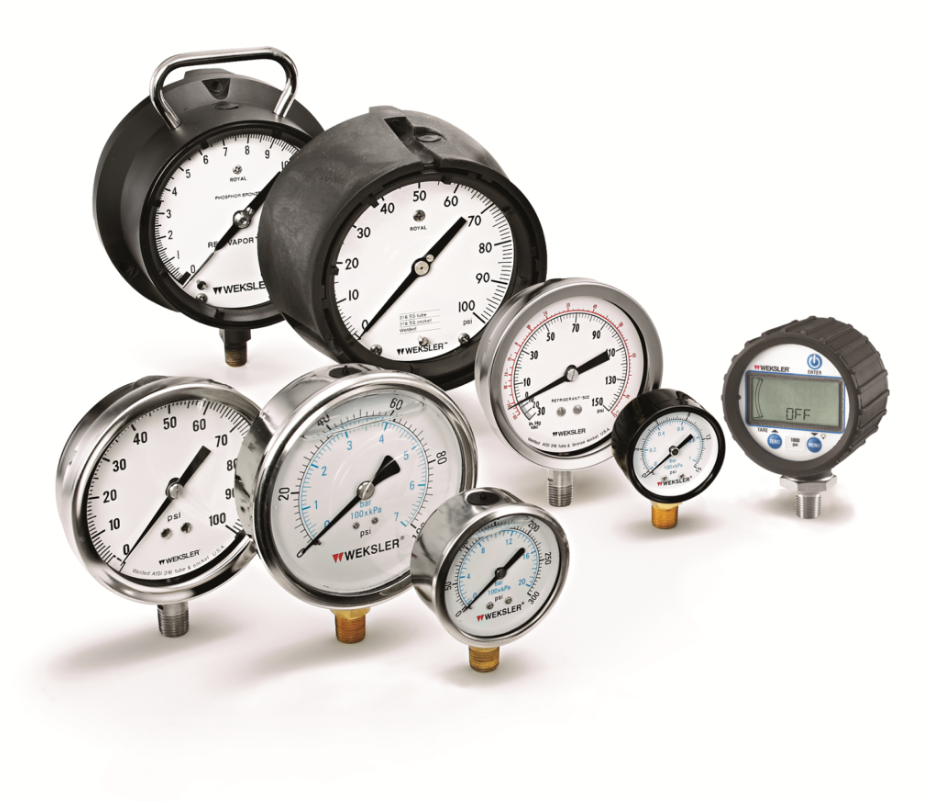
weksler WDG4251LPE4L Pressure Gauges
Description
RANGE
The maximum operating pressure should not
exceed 75% of the full-scale range. The normal
operating range should be in the middle half of
the range (between 25% and 75% of the full
scale range); whenever possible.
DIAL SIZE
Select a dial size that allows you to comfortably
read the dial from the normal distance when
installed.
PRESSURE SYSTEM MATERIAL
The media to which the gauge will be subjected
is critical to the selection of the proper material
for the Bourdon tube, bellows, and socket.
Weksler models are offered with:
Phosphor bronze Bourdon tube (or bellows)
with brass sockets.
Pressure Gauge Selection
316 stainless steel Bourdon tube (or
bellows) with 316 stainless steel sockets.
316 stainless steel Bourdon tube with alloy
steel sockets.
Monel Bourdon tubes with Monel sockets.
For applications where the above materials
may not be suitable, a diaphragm seal will
be necessary to protect the pressure gauge
system.
ACCURACY
Select a gauge with the desired accuracy as
follows:
±¼% – Test gauges only (not for in-line
service)
±½% – Weksler Royal gauges (41/2˝ dial
size and larger) and Weksler digital
gauges (21/2˝ case size)
±1% – Weksler Regal gauges, 100 MM
Gauge, EA14 gauge
±2-1-2% – Weksler duplex, differential and low
pressure gauges
±3-2-3% – Weksler BY12, BY42, UA15, UA20,
UA25, UA35 series utility gauges
MOVEMENT
Select either a gauge with 300 series stainless
steel movement for long wear or a gauge with
bronze or brass movement for applications
where vibration and pulsation are not present.
CASE
A wide variety of case styles and materials
are offered. Determine how the gauge is to
be mounted: direct, surface (wall) or flush (in
panel). Determine the desired case materials:
polyproylene (or phenol); aluminum (black
enameled) or stainless steel (300 series).
Determine case type:
Safety
(solid front with blow-out back)
Standard
(open front with rubber blow-out disc at rear)
Note – All safety case styles are designated
by a number. Standard case styles are
designated by a letter.
WINDOW
A glass face is standard in most gauges. If
breakage is a concern, a plastic or shatterproof
glass face is optional at extra cost on most
Weksler Royal and Regal gauges. (Glycerin
filled and sanitary gauges have plastic face as
standard).
POINTER
All Weksler gauges (except utility types) have
adjustable pointers. This permits pointer repo
sitioning during calibration check or allows
maximum precision at a specific point.
TEMPERATURE
The ambient temperature to which the gauge
will be subjected should not exceed 150°F. If
higher temperatures are encountered the gauge
must be isolated from the source of heat. The
temperature of the media to which the gauge
is subjected to is also critical. Gauges with
phosphor bronze Bourdon tubes should not be
subjected to process temperatures in excess
of 150°F. Gauges with metal cases and either
316 stainless steel or monel bourdons can
withstand higher process temperatures, but
as temperature exceeds 150°F hardening of
the gasketing and discoloration of the dial may
occur. In addition, accuracy will be affected
by approximately 1.5% per 100°F. Both 316
stainless steel and monel gauges in metal cases
will withstand 750°F for short periods of time
without rupture, but other parts of the gauge
will be destroyed and calibration will be lost.
VIBRATION
If present, a glycerin filled gauge is
recommended.
PULSATION
If present, a pressure snubber or throttle screw
is recommended